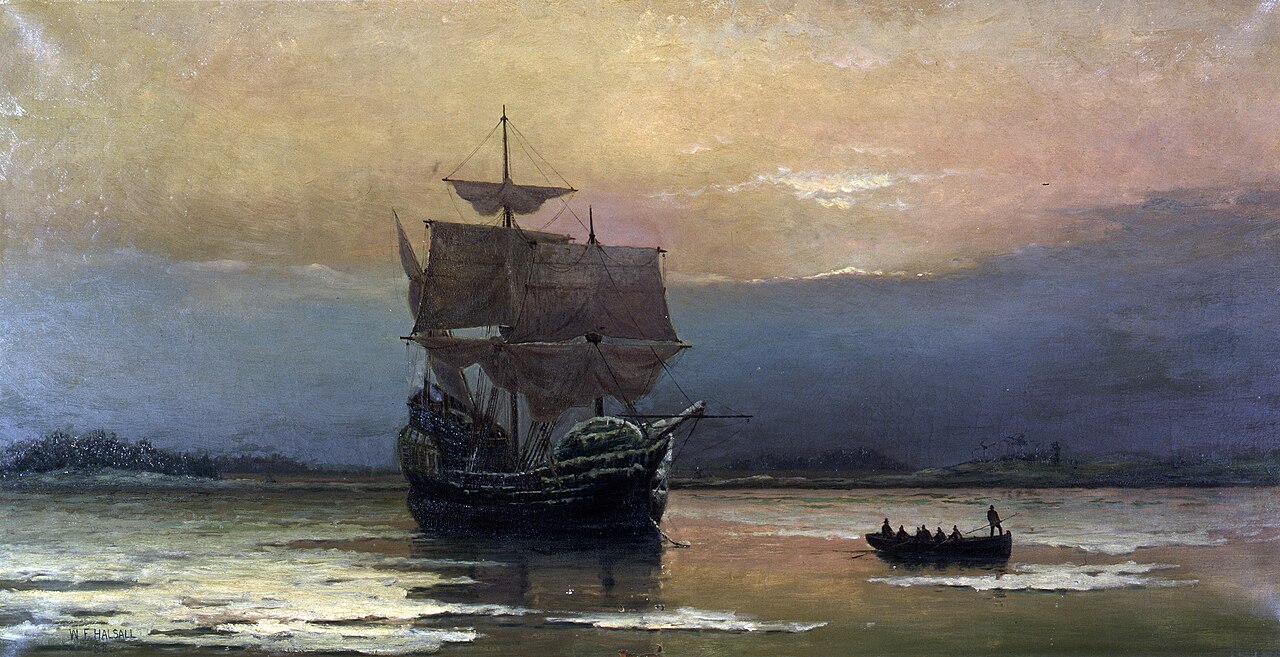
For most of its history this family told itself a simple story about its origins: the Livingstons were Scots who became Dutch-New York gentry, and they reached America in 1673, more than half a century after the Mayflower. By the Livingston name, that is exactly right, and it means the Livingston line has no claim to Plymouth at all. But a family is not one surname. It is every line that marries into it. And one of those lines, hidden in plain sight on the maternal side, runs all the way back to the Mayflower itself.
A family is not one surname. It is every line that marries into it.
The Mayflower Line
Where it enters the family
The Pilgrim blood enters the Livingston household in the twentieth century, with a single marriage. Dorothy Corser was a Livingston only by marriage; her own ancestry is pure New England. Her son John Livingston (1951–2019) and his generation are therefore the first Livingstons in this family who can claim Plymouth descent, and they can claim it only through their mother, not their Livingston father.
🚢 The headline
The family's Pilgrim ancestry is real, and it is well documented. It does not descend from any Livingston. It descends from Dorothy Corser (1927–2010), who married Edmund Pendleton Livingston Jr., and through her Corser, Totman, Rogers, Snow, and Hopkins forebears it reaches Mayflower passenger Constance Hopkins, who stepped off the ship at Plymouth in 1620 as a teenager.
The documented line
The descent below follows an Ancestry.com line, corroborated by published Hopkins, Snow, and Rogers genealogies and by the Jamestowne Society's records for the Totman family. It runs from the Mayflower to Dorothy in twelve generations.
| Gen. | Ancestor | Pilgrim link / note |
|---|---|---|
| 1 | Stephen Hopkins (c. 1581–1644) | Mayflower passenger, 1620; the only passenger who had already been to the New World |
| 2 | Constance Hopkins (1606–1677) | Mayflower passenger as a girl; married Nicholas Snow |
| 3 | Elizabeth Snow (1640–1678) | Daughter of Constance Hopkins and Nicholas Snow; married Thomas Rogers |
| 4 | Eleazer Rogers (1673–1739) | Born at Eastham; through his father descends from a third passenger, Thomas Rogers |
| 5 | Experience Rogers (1707–1750) | Married Samuel Totman; the line passes into the Totman family |
| 6 | Joshua Totman (1737–1808) | Removed to Colrain, Massachusetts |
| 7 | Thomas Totman (1763–1815) | Generation that began the move toward New York State |
| 8 | Ward Totman (1803–1892) | Settled at Bristol, Ontario County, New York |
| 9 | Levi Ward Totman (1842–1920) | Married Zylpha Marinda Moore |
| 10 | Grace Amina Totman Corser (1879–1957) | Married Henry Spencer Corser; the line passes into the Corser family |
| 11 | Levi Spencer Corser (1898–1979) | Married Eloise Mae Pettes; father of Dorothy |
| 12 | Dorothy Corser (1927–2010) | Married Edmund Pendleton Livingston Jr.; Pilgrim blood enters the Livingston family |
Not one Pilgrim, but three
The striking thing about this line is how many Mayflower passengers it gathers into a single descent. It carries:
- Stephen Hopkins, a 1620 passenger and a veteran of the earlier Jamestown venture, the only Mayflower passenger who had crossed the Atlantic before.
- Constance Hopkins, his daughter, also a 1620 passenger.
- Thomas Rogers, a third 1620 passenger, whose grandson Thomas Rogers married Constance's daughter Elizabeth Snow, folding a second Pilgrim family into the same line.
🧭 Why it was missed
Genealogies usually follow the surname. Tracing “Livingston” backward never finds Plymouth, because the Livingston name truly has no Pilgrim ancestry. The Mayflower line only appears when you stop following the surname and trace the maternal lines — Corser, then Totman, then Rogers, then Snow, then Hopkins — each of which changes the family name and so disappears from a surname-first search.
A timeline of the crossing
| Year | Event |
|---|---|
| 1620 | Stephen and Constance Hopkins and Thomas Rogers sail on the Mayflower; landing at Plymouth |
| c. 1627 | Constance Hopkins marries Nicholas Snow at Plymouth |
| 1640s–1670s | Snow and Rogers families settle and intermarry at Eastham on Cape Cod |
| 1700s | Rogers line passes into the Totman family; Totmans move to Colrain, Massachusetts |
| 1800s | Totmans migrate to Ontario County, New York |
| 1879–1927 | Totman line passes into the Corser family; Dorothy Corser born 1927 |
| 20th c. | Dorothy Corser marries Edmund Pendleton Livingston Jr.; the line joins the Livingstons |
What it means
This does not make the Livingstons a Mayflower family. It makes this family — the living descendants of Edmund and Dorothy — a Mayflower family, through their mother and grandmother. It is a reminder that the most interesting ancestry is often not in the name on the door but in the women who married into it and quietly carried four centuries of American history with them.
For the parallel question of how to actually join the hereditary societies, see Claiming the DAR and Mayflower Society: A Livingston's Guide. For the Livingston name's very different origin, see From Scotland to the New World.
People in This Story
Related Places
Sources
- Constance Hopkins — Pilgrim Hall Museum
- Stephen Hopkins (Mayflower passenger) — Wikipedia
- Constance Hopkins — Wikipedia
- Thomas Rogers (Mayflower passenger) — Wikipedia
- Nicholas Snow — Wikipedia
- Town of Eastham, Massachusetts
- General Society of Mayflower Descendants
- Story: From Scotland to the New World
- Story: Claiming the DAR and Mayflower Society