Two different families share the Livingston name, and the wrong crest circulates constantly. Most Livingston crest products show the Highland Clan MacLea / Livingstone of Bachuil badge: Saint Moluag holding a crozier. That is not the crest of the New York Livingstons.
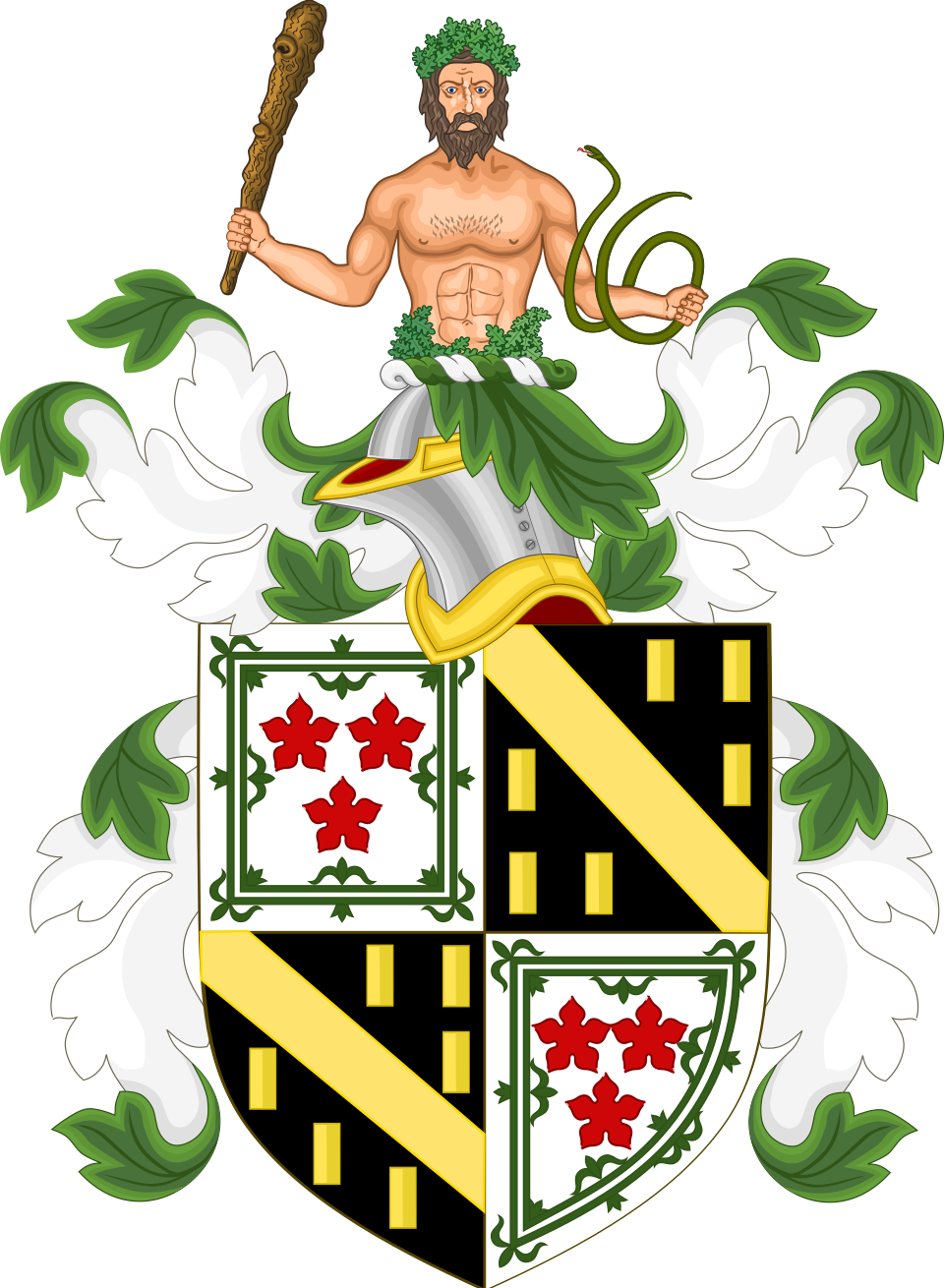
The New York family descends from the Lowland Livingstons of Callendar and Linlithgow in West Lothian. Their heraldry is the Si je puis achievement: a quartered shield, three red cinquefoils, the Callendar quarter, a demi-Hercules crest, and the motto If I can.
The Arms
The full achievement used by the family is quartered, combining Livingston with Callendar. The Callendar inheritance came into the family through a fourteenth-century marriage.
| Quarter | Blazon | Plain English |
|---|---|---|
| 1 & 4 - Livingston | Argent, three cinquefoils Gules, within a double tressure flory counter-flory Vert | A silver or white shield with three red five-petalled flowers inside a green double border of alternating fleurs-de-lis |
| 2 & 3 - Callendar | Sable, a bend between six billets Or | A black shield with a gold diagonal band flanked by six small gold rectangles |
The Crest and Motto
The crest above the shield is a demi-Hercules, or demi-savage, wreathed about the head and middle, holding a club in one hand and a serpent entwined about the other arm.
The motto is Si je puis, Norman French for If I can. The Highland Livingstones' Gaelic motto echoes it, which is one reason the two unrelated heraldic traditions are so often confused.
What the Elements Mean
- The three cinquefoils, or gillyflowers, are the defining mark of the Livingston name across branches.
- The double tressure flory counter-flory echoes the royal arms of Scotland and signals high standing and royal service.
- The Callendar bend and billets mark descent from the House of Callendar and, through it, the medieval Earls of Lennox.
- The demi-savage with club and serpent reads as strength joined to wisdom or prudence.
Why There Is No Single Livingston Crest
Under Scots law, administered by the Court of the Lord Lyon, arms belong to a person, not to a surname. There is no generic family coat of arms. Every legitimate bearer carries arms differenced from the head of the house.
That is why the Livingston stem produced a family of related but distinct shields as it branched into Callendar, Linlithgow, Kilsyth, Newburgh, Westquarter, Dunipace, Bonton, and Glentirran lines.
Cadet Branches
| Branch | How the arms differ |
|---|---|
| Livingston of that Ilk | Plain original arms: Argent, three cinquefoils Gules, without the royal tressure |
| Callendar / Earls of Linlithgow | Double tressure added and quartered with Callendar; the basis of the American arms |
| Viscounts of Kilsyth | Callendar arms differenced by a mullet at the center of the tressure |
| Earls of Newburgh | A heavily reworked shield with a blue fess and anchor between the gillyflowers |
| Westquarter and Dunipace | Differenced cinquefoil arms, with some inconsistency in historical usage |
| Glentirran | A branch that eventually abandoned the Livingston name and took the arms of Campbell of Ardkinglass |
Where the American Livingstons Fit
The New York family came from a clerical offshoot of the main Callendar stem: the ministers of Monyabroch, the old name for Kilsyth. John Livingstone was born there in 1603.
The American achievement recorded in Bolton's American Armory includes Linlithgow, Hepburn, and Callendar quarters. The Hepburn quarter likely points back to William, 4th Lord Livingston of Callendar, and his marriage to Agnes Hepburn.
More detail
The dedicated coat-of-arms guide includes the branch-shield image gallery and a fuller explanation of the wrong Highland crest.